
Views: 0 Author: Site Editor Publish Time: 2026-11-17 Origin: Site
Verify evidence, not eloquence. Registration papers, a live line walk, per-unit test records, a torn-down sample and a set of process questions — the five reinforce each other and together form a verdict.
Ask the camera to walk, not to play. A live, name-the-station video tour beats any promotional film; stations like SMT loading and the burn-in racks cannot be faked in real time.
Process records outrank promises. Archived, serial-numbered test data for every shipped unit is far harder to fabricate than a phrase like "strict quality control."
Tear the sample down. Wiring discipline, solder quality, transformer sizing and protection circuitry tell you what no listening session can.
The question sheet is the detector. Factories answer with stations, limits and procedures; intermediaries answer with adjectives.
Verifying a Chinese amplifier manufacturer comes down to one discipline: match every claim to something checkable before money moves. Five categories of evidence do the work — company registration documents, a live video walk of named production stations, per-unit test and burn-in records, a physically torn-down sample, and a short list of questions only someone close to the line can answer. None of it requires a flight; most of it happens over two email rounds and one video call. This article walks through each check, what to ask for, and which answers should stop the conversation.
The most expensive mistake in audio B2B sourcing is not receiving a mediocre amplifier. It is wiring a deposit to an entity that never had production capability in the first place — because that failure mode has no warranty path. Lead times, batch consistency and after-sales support all evaporate together, and the money is already gone. The script rarely changes: attractive samples, an eager quote, smooth communication, and not a single thread connecting any of it to a real production floor.
So the goal here is deliberately modest. You are not hunting for the "best factory." You are checking, before payment, whether the words on the other side of the screen reconcile with documents, footage, records and hardware. The five checks below build that reconciliation step by step, and every one of them names the evidence to request and the answers to treat as warnings.
Check | What you walk away with | Evidential strength | Typical effort |
|---|---|---|---|
1. Verify the registered entity | Business scope, certificate holder names | Eliminates shell entities | One email round |
2. Live video audit | Real-time footage of stations you name | Strong | One 20–40 minute call |
3. Request process evidence | Sample test records, burn-in procedures | Strong | One email round |
4. Tear down the sample | Solder, wiring, magnetics, protection circuitry | Strong | One sampling cycle |
5. Ask five process questions | Answer granularity as a proximity test | Moderate, corroborates 1–4 | One email round |
These are sequential filters, not a menu. Checks 1, 4 and 5 cost little, so start there; if either check 2 or 3 fails to reconcile, stop and reassess. Now each step in detail.
Cheapest first. What matters is not whether a business license exists but what it says:
Item to check | What to look at | Warning sign |
|---|---|---|
Registered business scope | Should include production / manufacturing categories | Only "trading / wholesale / import-export," no production category |
Registered vs. claimed address | Does it match the factory location they describe? | Registered in an office tower; factory address vague or different |
Certificate holder | The name on CE / FCC reports | Holder is not the contracting entity, relationship unexplained |
Certificate traceability | Report numbers searchable at the issuing body's database | Photos only, no numbers, or numbers that don't resolve |
The single most important move here: require that the entity name on the license matches the name on the future contract, the invoice and the certificates — identically. When the three don't line up, no matter how reasonable the explanation sounds, stop and ask.
A video audit is not "watch their promotional film." It is you naming a station and them walking the camera there, live. Films can be edited; real-time footage cannot. Skip the showroom and ask for the stations that cannot be substituted:
Station to name | Why it matters | What an evasive answer implies |
|---|---|---|
SMT loading and feeder area | Placement is the core process for amplifier main boards; feeders and reels cannot be improvised | The boards may be bought-in; assembly may be all they do |
Through-hole insertion and wave / selective soldering | Power amplifiers still carry large capacitors and discrete parts | A vague "advanced process" with no named line |
Burn-in racks | Rack count and wiring discipline reveal real capacity and quality investment | No burn-in area means "burn-in testing" is probably a phrase |
Final test station | Per-channel test fixtures and instruments should be visible and demonstrable | No live demo suggests outgoing inspection is sampling — or absent |
Packing and despatch area | Carton printing, cushioning, stacking practice | Uncontrolled outsourced packing moves transit damage onto you |
Two execution details decide whether this check is worth anything. First, book the call and have them take you through the line live — never accept a pre-recorded walk. Second, pause at one station and ask a concrete question ("how long does one unit occupy this rack?"). Someone who works on that line answers with a rhythm entirely different from someone reciting a script.

Figure 1 — A typical amplifier chassis of the kind a station-by-station audit should be able to trace from board loading to packed carton (typical construction).
"Good quality" is unverifiable. Process records are checkable. For outgoing amplifiers, the industry-standard asks are:
Process evidence | Typical form | Difficulty of faking |
|---|---|---|
Per-unit test records | Rated power, distortion, signal-to-noise measured per serial-numbered unit | High — volumes of data that must stay internally consistent |
Burn-in procedure | Written spec covering duration, loading method and patrol frequency | Medium — easy on paper, but it must match the racks you saw |
Outgoing quality (OQC) report | Per-batch sampling items with accept/reject criteria | Medium |
Referenced workmanship standards | Which soldering / assembly standards are cited, and where they apply | Medium — genuine adopters can name the exact process step |
How you phrase the request matters more than the request itself. Don't ask "do you have a quality system." Ask: "Send me one de-identified sample of an outgoing inspection report from any recent batch." A factory that keeps records can usually export one within minutes. One that answers by sending an ISO certificate photo is telling you where its quality data does not live.
The first three checks run online; this one returns to hardware. The sample is not for listening. It is for opening:
Observation point | What it reveals | Reading |
|---|---|---|
Board wiring | Power ground separated from signal ground; coherent routing discipline | Chaos vs. a documented board-level design rule |
Solder side | Joint consistency, bridges, cold joints, flux residue | The true standard of the insertion and soldering process |
Transformer and heat sink | Whether sizing matches the claimed power class; mounting method | Whether the hardware matches the brochure |
Protection circuitry | Actual DC protection, over-current and thermal components on board | Claims on a datasheet with nothing behind them are a finding |
Internal markings | Batch and serial numbers that echo the archive system | A factory with traceability marks its own hardware |
One further use of the sampling stage: order two units from the same batch and compare them item by item. Batch consistency is the lie detector of production control — one good unit can be hand-finished; two identical ones take a line.
The last check returns to writing. Ask five specific questions; the value is not in the answers but in their structure:
Question | Answer close to the line | Answer far from the line |
|---|---|---|
What fixed stations does final assembly have, and what tooling does each use? | Lists fixtures and their purpose, station by station | "Our production lines are very advanced" |
What is tested on a multichannel model before it ships? | Per-channel test items with pass limits | "Everything is strictly tested" |
How is burn-in run, and what happens on an interruption or anomaly? | Cites a written procedure and the escalation path | "We burn in for a long time, no problem" |
Which standard governs your soldering process? | Names the standard and the process step it applies to | "We follow international standards" |
How does warranty rework flow, and who carries parts cost? | Defines responsibility split and cost allocation | "We take care of any problem" (then silence) |
You don't need to fire all five at once; spread them across normal correspondence. The judging criterion is granularity. Answers that land on stations, items, limits and flows have a system behind them; answers made of adjectives have a sales script behind them.

Figure 2 — Rear panel interfaces of a typical multichannel amplifier; per-channel hardware of this kind is what per-channel test records should correspond to (typical construction).
Red flag | What it usually hides |
|---|---|
Promotional film offered instead of a live line walk | The line in the video may not be theirs |
Certificate holder and contracting entity don't match, explanation vague | Certificates may be borrowed or purchased |
Asking for an OQC sample returns only an ISO certificate image | The quality data system does not exist |
Quote far below comparable offers, cost structure unexplainable | Margin recovery later: substitutions, downgrades, added charges |
All contact through one person who never appears in workshop footage | The role may be a broker, not factory staff |
Perfect sample, refusal to discuss batch consistency control | The sample may be handmade; mass production is a different story |
One flag is a question. Two or more together mean it is time to either demand an on-site visit or walk away.
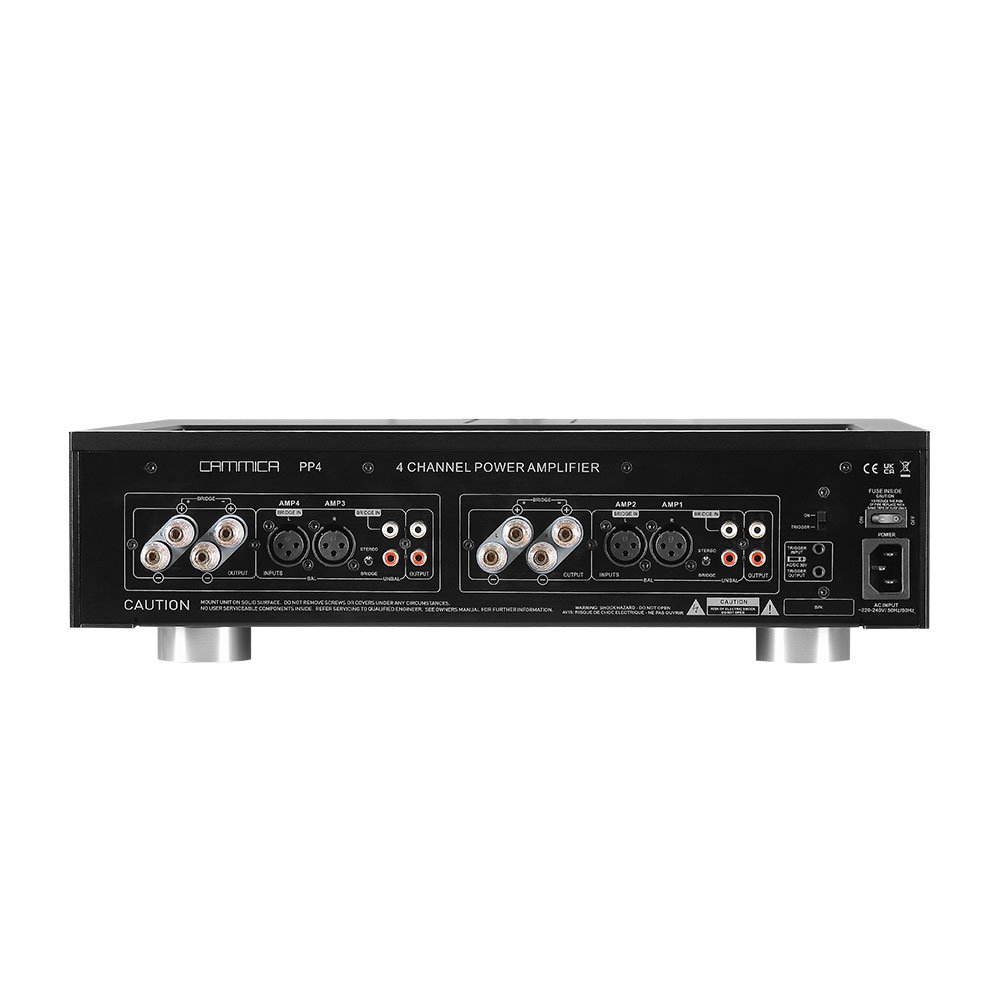
Figure 3 — Front panel build detail of a typical power amplifier; this is the level of finish a sample teardown is meant to confirm (typical construction).
Plenty of articles already cover how to tell an intermediary from a factory, and this one deliberately avoids repeating them. The distinction: identity checks answer "who is on the other side," while this article answers "what backs the factory claim." The evidence overlaps — lines, licenses — but the questions differ. A genuine factory can still deliver badly, and an honest intermediary that openly says "we don't manufacture" may still be a fine partner for some buyers. The five-step method above covers both cases, because what it tests is whether there is an evidence bridge between the promise and the delivery capability — not which label to pin on the counterpart.
Investment | Typical scale | What it buys |
|---|---|---|
Two email rounds + one video call | 1–2 hours combined | Eliminates most paper-only "factories" |
One sampling cycle | Days | Physical workmanship and batch consistency evidence |
On-site audit (only if checks 1–4 leave doubt) | One trip | The final word, plus management detail you can't see remotely |
The order is the point: online first, on-site second. Fly in before the remote checks and you will be shown the day they prepared for you; complete checks one to four, then visit, and you will see the line the way it runs on any Tuesday.
Misconception | Reality |
|---|---|
"Big factory photos mean it's a factory" | Images travel; only a live, named walk means anything |
"Full certificates mean safe" | Check that the certificate holder is the entity you're contracting |
"A good-sounding sample is enough" | Samples show craftsmanship; teardown shows the system |
"Verification will offend the supplier" | Real factories are audited routinely; the ones bristling are the ones to watch |
"Verify once and it's done" | New models, new lines and major volume ramps all justify re-checks |
"Cheaper is where my margin is" | An unexplainable low quote hides its cost somewhere you can't see |
Q1: If I never visit China, how far does this process get me? All five checks run remotely. Keep the site visit optional, and schedule it — if at all — once checks one to four are clear and the order is moving toward production. That is when a factory shows its normal operating day.
Q2: They asked to reschedule the video call, or offered a recording instead. Now what? Allow one reschedule. A second refusal to walk the line live should be handled per the red-flag list. A factory with nothing to hide has no reason to refuse twenty real-time minutes.
Q3: Won't test report samples expose another customer's data? No. Serial numbers and customer names can be masked; exporting one de-identified sample is routine in any archive-based system. Treating "confidentiality" as a reason to provide no sample at all deserves a follow-up question.
Q4: Will tearing down a sample signal distrust? Sample teardown is standard industry practice, and professional factories treat it as routine. Explain that it is an internal technical review — no need to apologize for it.
Q5: Does this method transfer to speakers, CD players and other audio categories? The framework transfers; the observation points change. For speakers, substitute cabinet, crossover and driver assembly for SMT and burn-in. For CD players, add transport sourcing and laser pickup supply to the question list.
Verifying an amplifier manufacturer is, in the end, a reconciliation exercise: match each claim to a document, a frame of footage, a record, or a piece of hardware. Entity papers checked for consistency, a live walk through named stations, process evidence with archives, a sample opened up to show the system, questions that measure granularity — run all five and the difference between a real production floor and a paper one resolves itself.
To see one real amplifier production line's stations and equipment directly, start with our factory production line and test equipment archive; this article belongs to our verification and sourcing series, collected in the amplifier engineering and sourcing knowledge base; and the amplifier and speaker ranges these lines build are on the in-production amplifier and speaker overview.


