
Views: 0 Author: Site Editor Publish Time: 2026-11-24 Origin: Site
For a 60 m² private cinema (roughly 180 m³, 8–12 seats), the industry-scale starting point is 150–300 W per channel at 8 Ω, an 11-channel 7.1.4 layout, fanless amplification, and a signal-to-noise ratio beyond 90 dB (A-weighted).
Loudness is the easy part. Getting reference-level SPL is straightforward at this volume; the hard parts are keeping hiss out of quiet scenes and getting through a two-hour screening without thermal throttling.
Size power backward from the SPL target at the farthest seat — not from floor area times a coefficient. Every 3 dB of speaker sensitivity halves or doubles the wattage you need.
Heat is a rack problem before it is an amplifier problem: intake, exhaust, and shelf spacing must be decided during fit-out, when changes are still cheap.
Noise floor is a system calculation: amplifier residual noise × speaker sensitivity × listening distance jointly decide whether a silent movie scene sounds black or hissy.
For a 60 m² private cinema, plan on 150–300 W per channel (8 Ω) across eleven channels in a 7.1.4 layout, with fanless amplifiers whose SNR exceeds 90 dB A-weighted — then spend your remaining effort on rack airflow and a system-level noise-floor check, not on bigger power numbers.
Three readers, three priorities:
Integrators and custom-install contractors: the constraint breakdown, the rack checklist, and the delivery-day checks — these three decide how often you get called back for rework.
Homeowners: the SPL arithmetic and the common mistakes — enough to judge whether the power figures on a quotation make sense.
Brand buyers and sourcing teams: the factory section — knowing which tests a cinema-grade multichannel unit should pass, and which records to ask for.
Speaker and amplifier selection starts with the room, not the catalog. A 60 m² private cinema imposes four hard constraints, and each maps to one technical decision:
Constraint | Typical magnitude | The decision it drives |
|---|---|---|
Volume | ≈ 180 m³ (60 m² × 3 m ceiling) | Strong low-frequency room gain; subwoofer count and placement have room to work |
Viewing distance | Farthest seat at 4–5 m | SPL targets and power are calculated at the farthest row |
Seating | 8–12 seats, two rows | The rear row sits in the front row's shadow; surround and height density must increase |
Finish quality | Ambient noise around NC-25–30 after acoustic treatment | The quieter the room, the lower the system's noise floor must be |
The fourth constraint gets missed most often: the quieter the room, the less the equipment can hide. A treated basement cinema can sit below NC-25 — in that environment, a residual hiss on the order of −70 dB is audible, where the same hiss in a family living room disappears under the refrigerator and the HVAC. So a proper evaluation for this application reads the room first and the amplifier second.
Power is not guessed; it is calculated backward from a target. Every step below is standard practice:
Target: roughly 105 dB peaks at the farthest seat (reference-level for a private cinema) Speaker sensitivity assumed at 87 dB @ 1 W / 1 m (a common in-wall figure)
Step | Calculation | Result |
|---|---|---|
1 W at 1 m | Read from sensitivity | 87 dB |
Power term | 10·log(200) ≈ 23 dB | 87 + 23 = 110 dB at 1 m |
Distance loss (4 m) | 20·log(4) ≈ 12 dB | 110 − 12 = 98 dB at 4 m |
Distance loss (5 m) | 20·log(5) ≈ 14 dB | 110 − 14 = 96 dB at 5 m |
Peak headroom gap | 105 − 98 ≈ 7 dB | Included in the 200 W assumption |
Two conclusions fall out of the table. First, around 200 W of genuine per-channel output at 8 Ω delivers 96–98 dB continuous at these distances with headroom toward 105 dB peaks — that is where the recommended 150–300 W band comes from. It is derived, not advertised. Second, sensitivity is the biggest lever in the whole equation. Move the speaker from 87 dB to 90 dB sensitivity and the wattage required for the same SPL halves; drop to 84 dB and it doubles. When you specify speakers for a room like this, the sensitivity row of the datasheet matters more than the finish.
One caveat on scope: this table covers full-range main channels only. Subwoofers keep a separate ledger — the LFE track demands higher peak SPL (on the order of 115 dB at reference level), and bass response is heavily shaped by room gain, so the arithmetic above does not transfer.
For a 60 m² room with two rows of seating, the mainstream landing point in the industry is 7.1.4:
Channel position | Count | Placement notes |
|---|---|---|
Left, center, right (LCR) | 3 | Center aligned to screen; left/right equidistant from the front row |
Surrounds (side + rear) | 4 | Mounted between the two rows' ear height, covering both rows |
Height (overhead) | 4 | Works best on flat ceilings 2.4–3.6 m high |
Subwoofers | 1–2 | Diagonal or front-plus-rear placement evens out seat-to-seat bass |
Eleven amplification channels are not a luxury here — four overheads and four surrounds are real speakers doing real work. How channel counts are tallied, what qualifies as an amplification channel, and when extra channels are wasted money: that accounting lives in our previous article on seven versus eleven channels, and this piece won't repeat it. The scene-level verdict is simple: for 60 m² and two rows, 7.1.4 is the floor, not a showpiece. A 5.1.2 layout in a room this size leaves the rear row under-surrounded and the height layer thin — and owners tend to notice within six months.
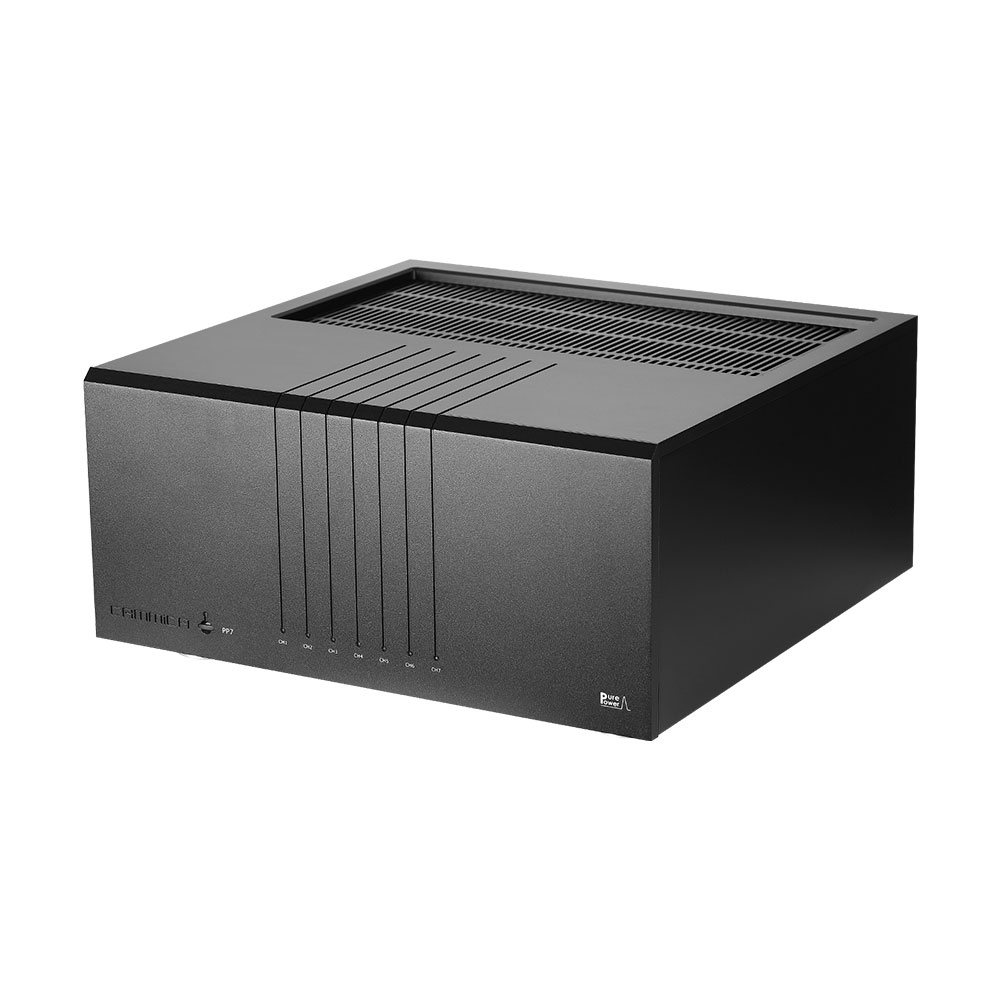
Typical multichannel amplifier construction (illustrative only)
In 180 m³, standing-wave wavelengths are the same order of magnitude as the room dimensions, and a single subwoofer rarely flattens every seat:
One sub, well placed, is a legitimate starting point — along the wall at roughly one-third of room length, or in a diagonal corner.
Two subs, diagonal or front-plus-rear, are the common upgrade: exciting room modes from multiple positions visibly narrows seat-to-seat bass variation.
Placement before wattage: the same budget buys more improvement in placement tuning — even a phone-based measurement app gets you most of the way — than in extra watts.
Remember it heats, too: a subwoofer's plate amplifier occupies no main-channel capacity, but its draw and heat belong in the rack's thermal budget.
Once power is settled, the heat ledger opens. A meaningful share of input power becomes heat — roughly half for Class AB, roughly a fifth to a third for Class D — and all of it is dumped into the rack:
Heat source | Order-of-magnitude estimate (industry-typical) | Where it goes |
|---|---|---|
Class AB, 11 channels at load | ≈ 50% of input power as heat | Rack air + heat sinks |
Class D, 11 channels at load | ≈ 20–30% of input power as heat | Same, at a smaller scale |
Subwoofer plate amplifiers | Single-digit to tens of watts at full output | Cabinet interior or rear plate |
Processors, players and the rest | Tens of watts each | Rack interior |
Across a two-hour screening, a multichannel amplifier spends most of its time at medium-to-high output — and inside a sealed cabinet with no convection, that heat pools directly behind the rear panel. Three things must be fixed during fit-out, not after:
Intake: at the cabinet base or front, where air is cool.
Exhaust: at the top, with low-noise fan assistance where passive convection isn't enough.
Shelf spacing: at least 1U of free space above and below the amplifier, so hot air has a path.
This section covers room- and rack-scale thermal planning only; component-level heat-sink design, derating in 40 °C ambient conditions, and protection behavior are a separate topic we treat elsewhere.
For home cinema, the noise-floor requirement is actually stricter than for two-channel hi-fi, for a blunt reason: the listener is close and the room is silent. With seats 3–4 m from the main speakers and ambient noise around NC-25, whether the system's residual noise is audible comes down to three multiplied factors:
Factor | How it enters | Typical requirement (industry-typical) |
|---|---|---|
Amplifier residual noise | SNR, A-weighted, at rated output | Beyond 90 dB; better units reach 100 dB-class |
Speaker sensitivity | More sensitivity amplifies more noise | High-sensitivity speakers demand cleaner amplification |
Listening distance | Closer seats expose more | Near-field positions are the least forgiving |
When reading a datasheet, pin down three qualifications of the SNR figure: A-weighted or unweighted? At rated output or at 1 W? Analog or digital input? The same unit can vary by well over ten dB across these wordings — an SNR quoted without its conditions has no comparative value.
The other audible culprit is a fan. Amplifiers for this application should be passively cooled. A low-noise extraction fan at the top of the rack is acceptable; a fan on the amplifier chassis itself is audible in quiet scenes, and nothing fixes it after installation. This is one of the dividing lines between home-cinema-grade and commercial-installation-grade designs.
Work through this list during fit-out — every item is cheaper on paper than in the room:
Depth: multichannel chassis commonly run around 400 mm deep, plus 50–80 mm for rear-panel connectors and cable bends; plan a 600 mm cabinet.
Load rating: Class AB multichannel units carry large transformers; rate shelves and fixings for heavy equipment.
Airflow: bottom-in, top-out; never sandwich the amplifier directly against processors or players that shed their own heat.
Cable separation: run speaker lines and signal lines in separate conduits; avoid long parallel bundles.
Service access: a removable panel behind the rear terminals — troubleshooting eleven channels is far faster through a side door than by sliding shelves.
Power: a dedicated circuit; put the subwoofer and the main amplifier on different phases to discourage ground-loop hum.
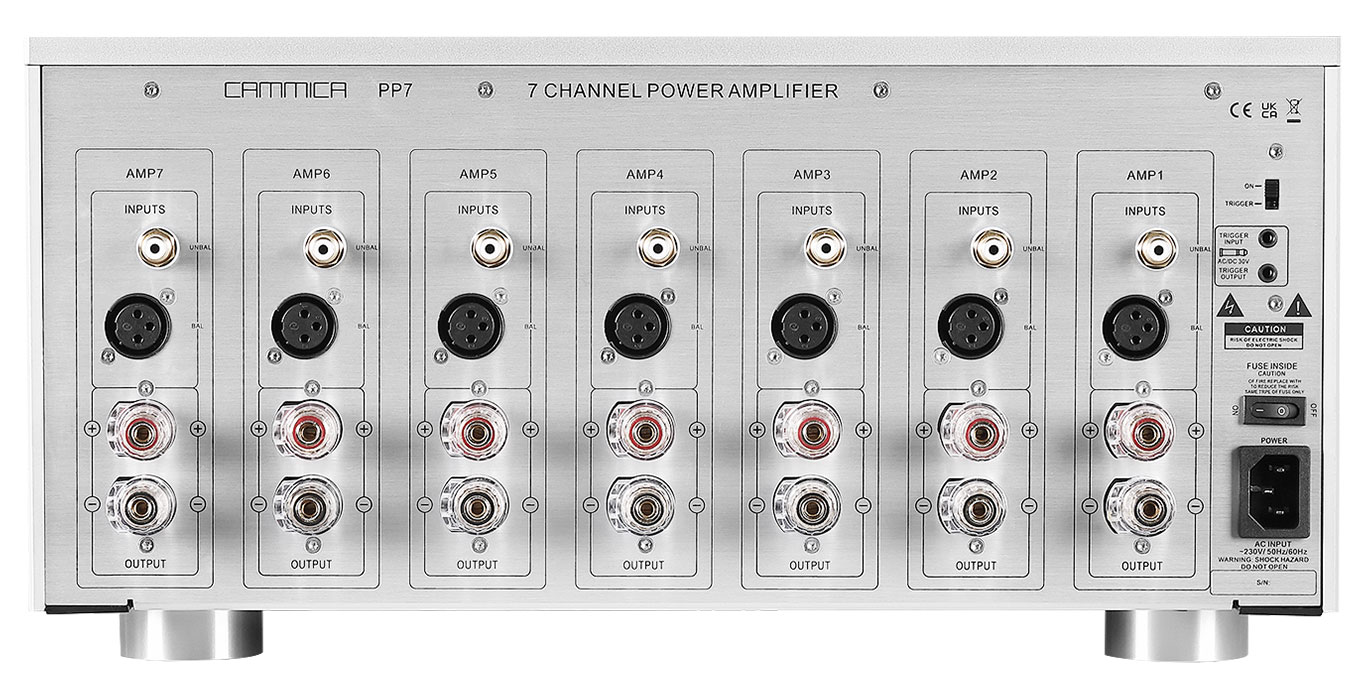
Typical rear-panel terminal layout of a cinema amplifier (illustrative only)
Scaling power from floor area: wattage follows farthest-seat distance and the SPL target; area is only an indirect variable.
Trusting peak over continuous ratings: a two-hour screening tests sustained output and cooling, not one-second peaks.
Ignoring sensitivity: 84 dB and 90 dB speakers differ by a factor of four in required power.
Packing the rack solid: the amplifier survives, but it derates half an hour into every screening and the sound shrinks as the evening goes on.
Putting a fan-cooled amplifier in the cinema: audible in quiet scenes, unfixable afterwards.
Copying the SNR number without its conditions: unweighted, 1 W figures flatter a product by a dozen dB.
Five spot-checks, no screwdriver required:
Listen to silence: power the system with no source playing at normal listening volume — no hiss or fan noise audible at the seats.
Pin the power conditions: ask whether per-channel power is quoted for one channel at 8 Ω or all channels driven; a vendor who volunteers the test conditions is pre-filtering themselves.
Feel the heat: after an hour of playback, heat-sink areas should run warm to hot — a normal order of magnitude — but a dead-silent rear exhaust means the rack airflow, not the amplifier, is the problem.
Ask for records: factory test sheets should cover all-channels-driven temperature rise and residual noise.
Walk the bass: play the same bass-heavy passage from several seats; large seat-to-seat differences call for repositioning or adding the second subwoofer.
Room | Layout | Per-channel power guide (8 Ω) | Watch out for |
|---|---|---|---|
20 m² living room | 5.1.2 | 80–150 W | Higher ambient noise; noise-floor demands can relax |
35 m² open-plan cinema | 7.1.2 | 100–200 W | Rack heat starts to matter |
60 m² private cinema | 7.1.4 | 150–300 W | Fanless amps + planned airflow + noise-floor accounting |
100 m²+ dedicated cinema | 9.x.6 | 250 W and up | Zoned amplification; professional acoustic design on board |
All figures are industry-scale illustrations for aligning expectations — not upper limits, and not commitments.
On the production line, cinema-grade multichannel units pass three tests that map directly onto this article's constraints, beyond the standard per-channel checks:
Test | Method | Which constraint it validates |
|---|---|---|
All-channels-driven temperature rise | All channels at rated load simultaneously; heat-sink and transformer temperatures logged | Heat: no derating across a screening |
Residual noise | Rated gain, input terminated per spec, A-weighted output measurement | Noise floor: silence in quiet scenes |
Extended burn-in | Full speaker complement run for hours, drift recorded | Combined validation of both |
When you buy a brand or commission a factory, whether these three records can be produced on the spot says more than the words "we are a factory" ever will — records can be opened today and audited later; claims cannot.
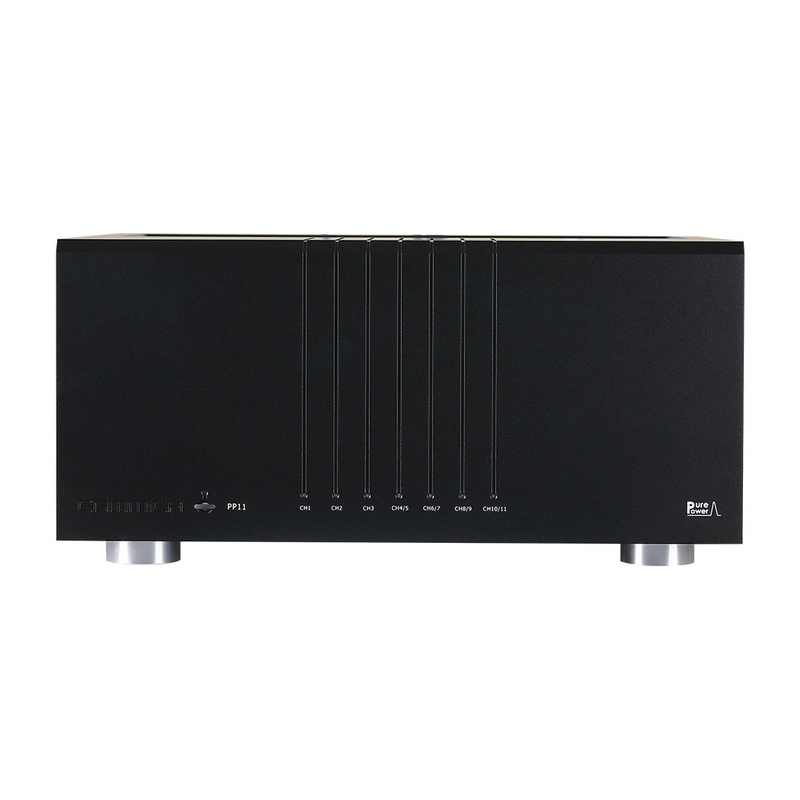
Typical front panel of a cinema-grade multichannel amplifier (illustrative only)
For a 60 m² private cinema, the power calculation is one-third of the job and takes ten minutes; rack airflow and system noise floor are where the project's quality actually separates itself. To see where equipment of this class is built, start with the factory floor and test documentation behind villa-scale cinema builds; this piece belongs to our scene-configuration series, collected in our field notes on room-scale cinema design; and the cinema amplifiers and in-wall speaker lines currently in production are listed at the cinema amplifiers and in-wall speaker lines currently in production.


