
Views: 0 Author: Site Editor Publish Time: 2026-11-23 Origin: Site
Images are generic illustrations of audio manufacturing and depict no specific model; all figures are industry-typical order-of-magnitude illustrations, not pricing, MOQ or lead-time commitments.
A channel is one independent amplification path inside the amplifier — not a speaker count. The ".1" in 7.1 is a subwoofer output jack and occupies no amplification channel.
Layout sets the floor, usage sets the ceiling: 7.1 needs seven channels; 7.1.4 needs eleven.
Extra channels earn their keep in three ways: height speakers, Zone 2 distribution, or bi-amping — and bi-amping is the weakest reason of the three.
Buying eleven channels to run a 5.1 system buys nothing: idle channels produce no sound pressure, they only consume power supply headroom and budget.
Three questions settle the choice: what is your speaker layout, do you have height speakers, do you need Zone 2?
Whether you need more channels depends on one thing only: how many speakers you actually connect. Five-point-one and 7.1 systems are fully served by seven channels; the eighth through eleventh channels only start working once height speakers or a second zone enter the picture.
One channel is one complete amplification path: its own output stage, its own speaker terminals, its own protection. The surround processor splits a soundtrack into separate signals, and each signal needs one channel driving one speaker. Mixing up the two numbering systems is the most common confusion at purchase: "7-channel amplifier" counts amplification paths inside the chassis, while "7.1" describes a speaker layout in which the ".1" — the subwoofer — is fed from a dedicated line-level output into a self-powered sub, drawing nothing from the amplifier's internal channels.
The last digit works differently. In 7.1.4, the ".4" means four overhead (height) speakers, and those must be driven by real amplification channels — there is no built-in amplifier to lean on. This is the entire reason eleven-channel amplifiers exist: seven ear-level speakers plus four height speakers equal eleven channels of amplification demand.
Layout | What the digits mean | Amplification channels needed |
|---|---|---|
5.1 | L/C/R + two surrounds + powered sub | 5 |
7.1 | 5.1 plus one pair of rear surrounds | 7 |
5.1.2 | 5.1 plus two overhead speakers | 7 |
7.1.2 | 7.1 plus two overhead speakers | 9 |
7.1.4 | 7.1 plus four overhead speakers | 11 |
9.4.6 | Nine ear-level + six overhead, flagship tier | 15+ |
The reading rule is simple: add the first digit (ear-level) and the last digit (overhead); the middle digit is subwoofer count and never enters the sum. Buyers routinely read 7.1.4 as "7+1+4 = 12 paths" when it is actually eleven — the ".1" runs on its own output jack and occupies no channel.
One further trap hides in the word "channel" itself. Spec sheets use it in three different senses, and they are not interchangeable:
What the sheet says | What it actually means | What you still need |
|---|---|---|
Decodes 11 channels | The processor can split 11 signals | Not one amp channel guaranteed |
11 pre-out jacks | Eleven line-level outputs | A separate power amp per output |
11 amplification channels | Eleven real output stages inside | Nothing — hook up and go |
The expensive mistake is the third row. Some integrated units blur decoding and amplification in the same figure: the chassis decodes eleven channels but amplifies only nine, leaving the last two as pre-outs. A buyer wires eleven speakers to an "11-channel" unit, the two overheads stay silent, and the speakers get blamed. The check takes seconds: count the speaker binding-post groups on the rear panel — that number is the amplification channel count; RCA pre-outs do not count.
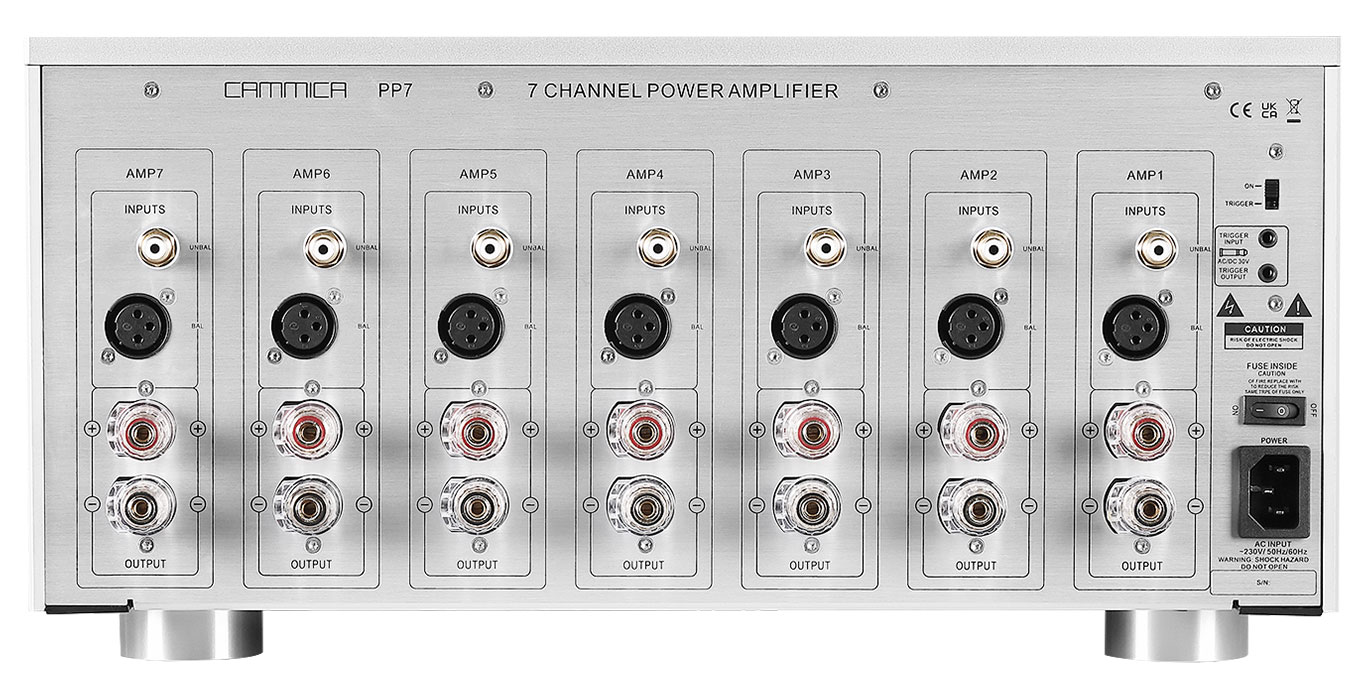
Typical rear-panel channel terminal layout (illustrative only)
Channels beyond your current layout are bought for four jobs:
Use | How it works | Notes |
|---|---|---|
Height channels | Overhead speakers fed by Atmos-type object tracks | The main reason to step from 7.1 to 7.1.4 |
Width channels | Speakers at roughly 45–60° off the front stage | Supported by some formats; widens the front soundstage |
Zone 2 / Zone 3 | Two or more channels redirected to another room | Cinema downstairs, background music in the dining room |
Bi-amping | Two channels drive one speaker's bass and mid/high sections | Requires binding posts and genuine crossover separation |
Bi-amping deserves a warning. It asks the speaker to expose separate high and low pass sections, and most consumer crossovers do not truly isolate the bands — the payoff is often marginal. Buying extra channels for bi-amping is the lowest-return use of money on this list.
A standard 7.1 living-room cinema: seven ear-level speakers plus a powered sub. Seven channels, fully loaded, zero waste.
A 5.1 system with upgrade plans: run 5.1 today; the spare two channels absorb a rear-surround pair or a first pair of overheads later.
A small-room 5.1.2 Atmos system: five ear-level plus two overheads fills seven channels exactly. In rooms around 20 m², two overheads already establish convincing height cues.
What these three have in common: every amplification channel drives a real speaker. That is the test of money spent on sound rather than on specification.
A complete 7.1.4 cinema: the native habitat of the eleven-channel amplifier. Every channel works; none idles.
7.1 plus Zone 2: the main room runs full 7.1 while two to four channels feed a terrace, kitchen or dining area with background music, independently selectable.
A large-room 9.1.2 layout: the ear-level ring widens to nine speakers with two overheads, eleven channels total.
Channels nine through eleven therefore answer a different question than Atmos does. Height speakers upgrade how a movie sounds; Zone 2 upgrades how the house is used every day. Judging whether your lifestyle needs Zone 2 is often more practical than judging whether you need height channels, because the two upgrades differ completely in frequency of use.
The mirror case is just as clear: if the current system is 5.1 and no height speakers are planned, eleven channels are pure inventory — idle channels produce no sound pressure, only a claim on power supply capacity and budget.
Multichannel units quote power two ways: per-channel (a single channel into a stated load) and total (all channels combined). The relationship between them is set by the power supply, not by multiplication:
Quoted figure | What it describes | The second question to ask |
|---|---|---|
100 W per channel @ 8 Ω | Achievable by one channel working alone | What is it with all channels driven? |
700 W total | A ceiling for all channels combined | Sustained simultaneously, or dynamic peak? |
100 W per channel, all channels driven | The per-channel value under full load | — this is the real cinema operating point |
Industry rule of thumb: when total supply capacity is fixed, doubling the channel count discounts the per-channel power available with all channels driven, and the discount depends on the supply architecture — toroidal transformers store more energy, switch-mode supplies respond faster — and on thermal headroom. This is why serious multichannel specifications distinguish "single channel" from "all channels driven" conditions. A sheet that prints only one number says nothing about how the amplifier behaves in an actual film.
From the factory floor, every additional pair of channels buys more than two amplifier boards:
Cost item | How it scales with channel count | Where the buyer can see it |
|---|---|---|
Power supply | Redesigned around total current draw; larger transformer and bus capacitance | Noticeable jump in chassis weight |
Thermal design | Larger heat-sink area, re-planned airflow | Fin density on side and top panels |
Chassis structure | Longer rear-panel terminal field, extra internal wiring layers | Rows of input/output terminals on the back |
Test hours | Per-channel testing, then full-channel combined testing | Channel-consistency pages in test records |
Failure-rate base | Channel count multiplied by per-channel failure rate | Warranty terms and channel coverage |
Channel count is the steepest segment of the cost curve because it lifts the power supply, thermal, mechanical and test budgets at the same time — which is why the price gap between seven and eleven channels has never been just "four more boards."
Class D has changed the physics but not the verdict. High switching efficiency — commonly quoted at 80%-plus against roughly 50% for Class AB — is what makes an eleven-channel design fit a conventional chassis at all. Yet efficiency does not remove the supply constraint: a Class D stage draws directly from the supply bus, every transient is carried by bus capacitance and supply response, and more channels mean more risk of bus voltage sag under full load. The evaluation order for any multichannel unit should therefore be power supply and thermal design first, channel count second. An eleven-channel unit with a thin supply can deliver less per channel, all channels driven, than a well-fed seven-channel unit — the real contest between 7 and 11 is not the number, it is how much headroom each channel keeps at full load.
Height channels demand more from the room than ear-level speakers do:
The soundtrack actually carries height information: Atmos-type object tracks do; upmixing stereo adds very little.
The ceiling suits the geometry: flat ceilings in the common 2.4–3.6 m range work well; sloped or double-height ceilings dilute the effect.
The overhead speakers aim correctly: downward radiation covering the listening area, not the floor.
The ear-level layout is already right: height is an addition, and it cannot rescue a badly placed 7.1 base layer.
If fewer than two of the four conditions hold, defer the height channels. When all four hold, in a dedicated basement cinema or a wide flat living space, the sense of elevation is something no arrangement of ear-level speakers can reproduce. Skip the channels that would sit idle; do not skip the channels that will genuinely work.
Current setup | Plan for the next 1–2 years | Recommended channels |
|---|---|---|
5.1 | No additions | 5 (or 7 for upgrade headroom) |
5.1 | Rear surrounds or first overhead pair | 7 |
7.1 | No additions | 7 |
7.1 | Two overheads | 9 |
7.1 | Four overheads, or Zone 2 | 11 |
7.1 | Bi-amp the main speakers only | 7 — do not add channels for bi-amping |
One footnote on notation: when the middle digit rises from 1 to 2 (7.2.4, 9.2.6), that digit counts subwoofers, not amplification channels. A second subwoofer exists to smooth seat-to-seat bass by exciting room modes from multiple positions, and every subwoofer runs on its own plate amplifier regardless of whether the notation reads .1 or .2.
Counting 7.1.4 as twelve paths: the ".1" occupies no amplification channel; 7.1.4 is eleven.
Trusting decoded channels or pre-outs as amplification: count speaker binding posts on the rear panel, not RCA jacks.
Dividing total power by channel count to get per-channel power: the all-channels-driven figure is the real operating point.
Buying eleven channels to run 5.1: idle channels produce no sound pressure; they consume supply headroom and budget.
Adding channels for bi-amping: most consumer crossovers do not isolate the bands, so the return is marginal.
Ignoring heat and placement: fully loaded multichannel units run hot; sealed cabinets need airflow clearance and service access.
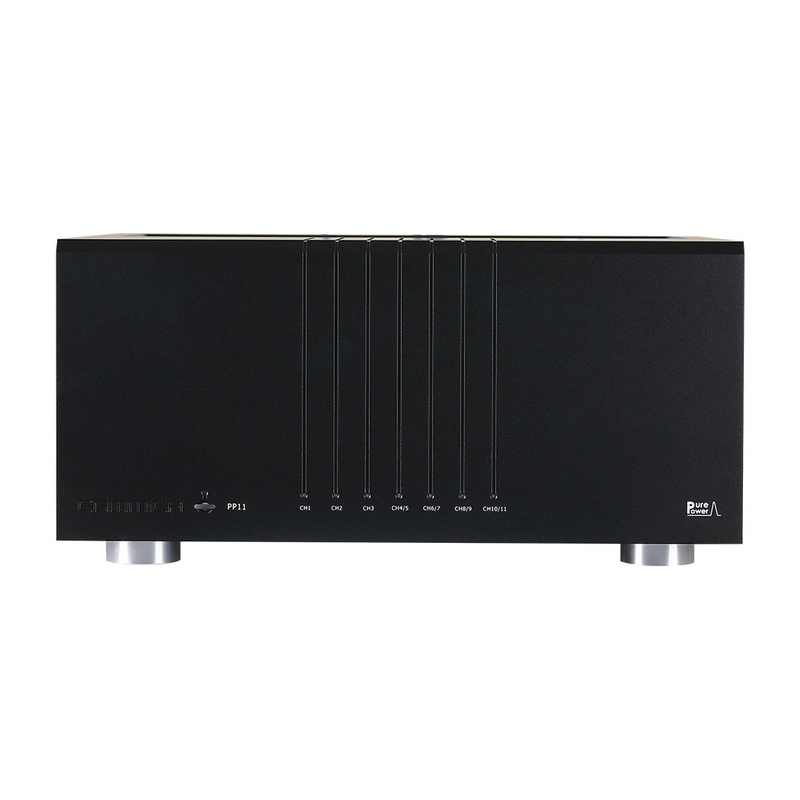
Typical multichannel amplifier front panel (illustrative only)
Channel count does not multiply test hours linearly; it splits them into two stages: per-channel verification, then full-system combined testing.
Test stage | Items | Purpose |
|---|---|---|
Per-channel | Rated power, gain, noise floor, protection trigger | Every path must pass on its own |
Channel consistency | Gain and output deviation between channels held very tight | The precondition for stable imaging in a cinema |
Full-channel combined | Temperature rise, supply voltage sag, crosstalk under simultaneous drive | Simulates the real full-load film night |
Extended burn-in | Continuous run at full speaker complement | Exposes thermal drift and early-life failures |
The single most useful document a buyer can request is the channel-consistency record. Excess gain deviation between channels drifts the sound image no matter how carefully the speakers are placed — the largest quality-judgment difference between multichannel cinema amplifiers and two-channel hi-fi.
Delivery-day spot-checks need no screwdriver:
Count the terminals: binding-post groups must equal the quoted channel count.
Walk the channels: feed the same test speaker or pink noise through each channel in turn; every one must produce sound at matched level.
Read the records: factory test sheets should cover both the per-channel stage and the combined stage; a missing stage is a question, not a formality.
Exercise the protection: after a triggered fault, the unit should reset and channels should not drag each other down.
Leave room to breathe: after an hour at load, heat-sink areas may be hot to the touch — a normal order of magnitude — but blocked rear-panel exhaust is a placement problem, not a tolerance.
These five checks are the twenty-minute, buyer-side sampling of the same per-channel, consistency, combined and burn-in stages the production line runs for hours.
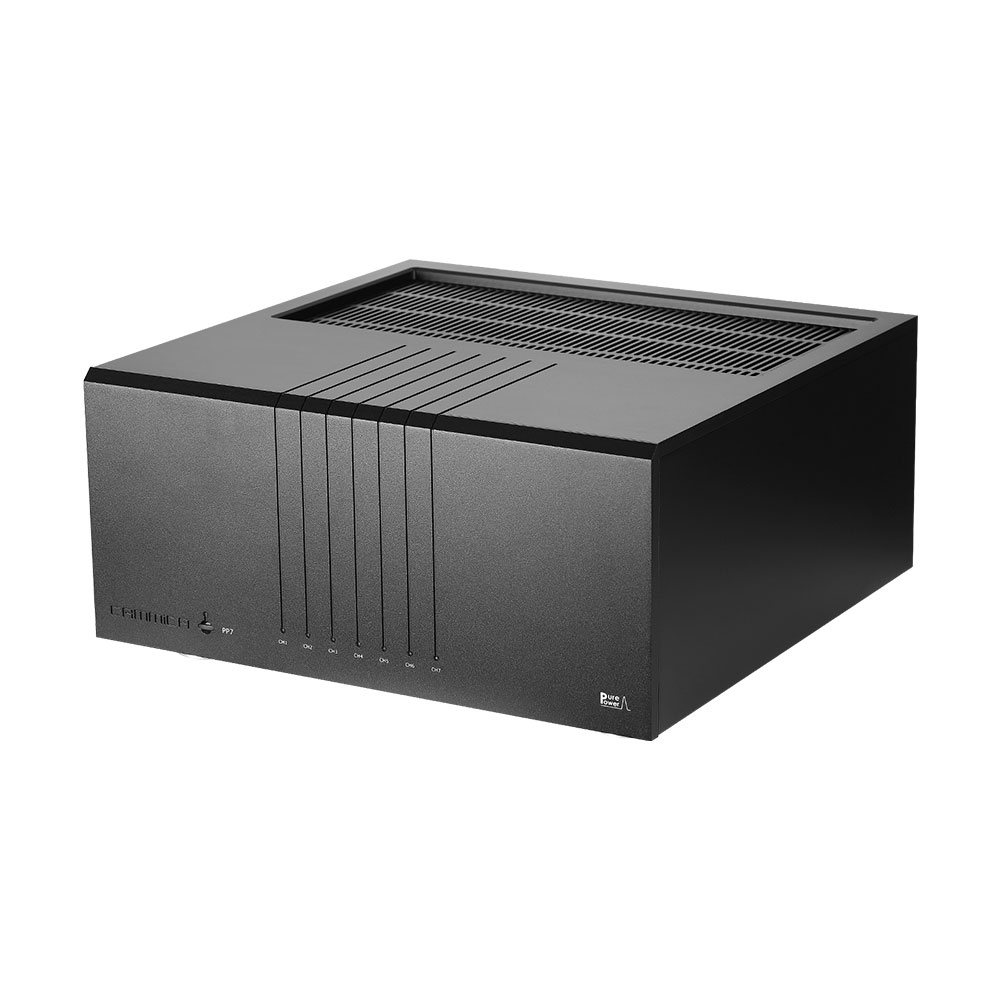
Typical seven-channel amplifier construction (illustrative only)
Reduce the decision to three questions: what is the speaker layout, are there height speakers, is Zone 2 needed? Once those are answered the channel count is fixed, and comparison should move to per-channel power under all-channels-driven conditions, supply and thermal construction, and the channel-consistency test records. To see the production lines and test conditions behind multichannel platforms of this kind, start with the production lines that build seven- and eleven-channel platforms; more articles in this series are collected in our notes on channel planning and layout selection; and the in-production amplifier lineup these channel architectures apply to is listed in the in-production amplifier lineup behind these channel architectures.


