
Views: 0 Author: Site Editor Publish Time: 2026-11-28 Origin: Site
Required amplifier power is a four-input calculation: speaker sensitivity sets the starting point, listening distance sets the loss, target SPL sets the endpoint, and dynamic headroom sets the peak. Fill in all four and the wattage answer is arithmetic, not opinion.
Direct sound drops about 6 dB for every doubling of distance. Moving the listening position from 2 m to 4 m costs the speaker a full sensitivity grade.
Every 3 dB of extra sensitivity halves the power you need — a more sensitive speaker usually beats a bigger amplifier on value.
Wattage ratings carry four reading traps: peak versus rated power, dual-impedance figures, total versus per-channel output, and unstated test conditions.
Room area converts to a per-channel power range, but ceiling height, open floor plans, and heavy absorption all push the number up a tier.
Once a powered subwoofer takes over the bass, the main amplifier channels do not need to be sized for the loudest moment of the movie.
The wattage a home theater channel needs comes from four inputs — sensitivity, distance, target SPL, and headroom — and each one is measurable. Nail those down and the question "how many watts?" turns into a one-line calculation that any spec sheet can be checked against.
Home theater buyers — use the worked example and the room-size table to check whether a quoted wattage is realistic or marketing.
Brand owners and product managers — turn "we recommend 150 W" into a repeatable calculation that survives a spec-sheet review.
Installers and integrators — the correction checklist gives a defensible answer when a client asks why rooms get different amplifiers.
The question "how much power for my room" has no standard answer as asked; it is missing its inputs. The complete version is: with how sensitive a speaker, at what listening distance, to what loudness, with how much headroom? Those four values are the starting point, the loss term, the endpoint, and the safety factor of one calculation. Leave any of them out and every wattage debate floats free of reality.
Input | What it means | Typical range (industry-typical) |
|---|---|---|
Speaker sensitivity | SPL produced at 1 W input, 1 m distance | Floorstanders commonly 84–90 dB; in-wall and in-ceiling 85–89 dB |
Listening distance | Straight-line distance to the main seat | Living rooms 2.5–4 m; dedicated cinemas 3–5 m |
Target SPL | The average loudness you actually want | Casual listening 70–80 dB; reference level 85 dB |
Dynamic headroom | How far peaks rise above the average | 10–12 dB minimum; more for movie soundtracks |
Only the first input is printed on the speaker's spec sheet. The other three are yours to fill in — and filling them wrong distorts everything downstream.
The industry-standard approximation reads: required power (W) = 10^((target SPL + distance loss − sensitivity) ÷ 10), where distance loss = 20 × log10(distance in meters). If that looks abstract, walk the table below instead — each row is one multiplication.
Worked example (illustrative values): 87 dB sensitivity, 3 m listening distance, 85 dB target average SPL, 12 dB headroom.
Step | What is calculated | Result |
|---|---|---|
1. Starting point | SPL at 1 m from 1 W of input | 87 dB |
2. Distance loss | 20 × log10(3) | ≈ −9.5 dB |
3. Power for average SPL | 10^((85 + 9.5 − 87) ÷ 10) | ≈ 5–6 W |
4. Peak SPL target | 85 + 12 = 97 dB | power × ≈16 |
5. Power for peaks | 6 W × 16 | ≈ 90–100 W |
Row three is the eye-opener: pushing an 87 dB speaker to an 85 dB average at three meters takes single-digit watts. The one- and two-hundred-watt ratings on amplifier spec sheets buy row five — the peaks. That is why "daily listening needs only a few watts" and "we recommend a 150 W amplifier" are both true at once.
The inverse-square law has one practical sentence for home theater: every doubling of listening distance costs about 6 dB of direct sound. Two meters to four meters, six decibels; three meters to six meters, the same. And because every 3 dB costs a doubling of power, doubling the distance quadruples the power requirement.
Listening distance | Loss relative to 1 m | Average power for 85 dB target, 87 dB speaker |
|---|---|---|
2 m | ≈ −6 dB | ≈ 3 W |
3 m | ≈ −9.5 dB | ≈ 6 W |
4 m | ≈ −12 dB | ≈ 13 W |
5 m | ≈ −14 dB | ≈ 20 W |
(Illustrative values; room gain and headroom not included.)
This one row explains two familiar experiences. A small room lets a modest amplifier drive big floorstanders to uncomfortable levels; a large living room makes the same system sound thin at the far seat. The amplifier has not changed — the distance term has. Open-plan spaces lack the reflective support of enclosed walls and lean harder on raw power; corrections follow.
Each 3 dB of sensitivity halves the power needed for the same loudness; 6 dB cuts it to a quarter. A 100 W amplifier driving an 87 dB speaker reaches roughly the same ceiling as a 25 W amplifier driving a 90 dB speaker. Checking sensitivity before shopping for wattage is the highest-value move in the whole exercise.
Sensitivity difference | Power needed for equal loudness | Amplifier tier change |
|---|---|---|
+3 dB | halved | 100 W tier → 50 W tier |
+6 dB | quarter | 100 W tier → 25 W tier |
−3 dB | doubled | 100 W tier → 200 W tier |
Sensitivity is not free: high-sensitivity designs trade box volume and driver choices, and low-frequency extension or distortion may give way. In-wall speakers, constrained by wall depth, mostly sit between 85 and 89 dB. Fix the target SPL and headroom from your room first, then balance sensitivity against power — never judge either number in isolation.
One spec-sheet caution: sensitivity appears in two conventions, "XX dB (1 W/1 m)" and "XX dB (2.83 V/1 m)". For an 8 Ω speaker, 2.83 V equals 1 W, so the numbers match. For a 4 Ω speaker, 2.83 V is 2 W — the rating reads about 3 dB higher for free. Confirm the convention before comparing two speakers, or the 4 Ω model wins 3 dB it did not earn.
An 85 dB average is the reference-level convention of film mixing rooms — not the volume most people use on a Tuesday night. Casual viewing sits at 70–80 dB; late-night sessions drop into the sixties. Sizing for 85 dB is still correct, but know what you are buying: a system built to reference level spends most of its life in the lowest fraction of its power range.
Listening scenario | Target average SPL (illustrative) | Character |
|---|---|---|
Late-night viewing | 60–70 dB | Low-power zone; any competent amplifier covers it |
Everyday viewing | 70–80 dB | Where most systems actually live |
Film reference level | 85 dB | The mixing-room convention; the precondition for full dynamics |
Demonstration or party mode | 90 dB+ | Peak-heavy; power is decided by headroom |
The goal is dynamic range, not permanent loudness. A system designed for reference level with real headroom, operated daily at 70 dB, is a healthy system: every transient has clean reserves, and the amplifier never works near clipping.
Movie soundtracks carry transient peaks 12 dB or more above the average level, and some effects passages exceed that. Every 3 dB of headroom doubles the power demand: an 85 dB average plus 12 dB asks the amplifier to deliver instantly and cleanly about sixteen times its average power. Clipped watts buy nothing.
Headroom tier | Peak vs. average | Typical use |
|---|---|---|
6 dB | ×4 | Background music, dialogue-driven shows |
10–12 dB | ×10–16 | The standard recommendation for movie soundtracks |
15 dB+ | ×32+ | Reference-grade dynamics in large dedicated rooms |
Its signature is recognizable: harshness and congestion on big dynamic passages, sudden grain in the highs — the amplifier clipping, not the speaker failing. In the worked example the average SPL sets only a floor; headroom sets the number you actually quote.
Power specifications have no single enforced standard, and one amplifier can carry very different numbers under different conditions. Before comparing two wattage ratings, check four things.
Trap | What it looks like | How to check |
|---|---|---|
Peak vs. rated (RMS) | "Peak power 1000 W" | Read only rated/continuous output; ignore peak figures |
Dual-impedance figures | "200 W (4 Ω) / 100 W (8 Ω)" | Match the figure to your speaker's impedance, not the larger one |
Total vs. per-channel | "700 W total output" on a multichannel unit | Divide by channel count, then run the calculation |
Unstated test conditions | No distortion figure, no band width | Ask: at what distortion, over what frequency band, into what impedance |
The fourth is the quietest: a "100 W" measured on a single 1 kHz tone at 1% distortion and a "100 W" measured across the full band at 0.1% represent very different drive capability. Manufacturers who print test conditions in full usually have test benches that stand up to a factory visit.
For those who would rather not run the formula, the table below converts common room sizes into per-channel rated power ranges. It assumes 86–89 dB sensitivity, a 3–4 m listening distance, an 85 dB target, 12 dB of headroom, and an 8 Ω load. Every deviation from those assumptions moves the answer — corrections follow.
Room area (illustrative) | Typical setting | Per-channel rated power range (8 Ω, illustrative) |
|---|---|---|
≤15 m² | Study or desk cinema | 20–60 W |
15–25 m² | Bedroom or small living room | 50–100 W |
25–40 m² | Main living room theater | 80–150 W |
40–60 m² | Dedicated cinema room | 120–250 W |
>60 m² / open plan | High-ceiling or connected spaces | 200–350 W, with subwoofers carrying the bass |
Two cautions: the top of each range is not a mandate, it is where headroom starts to feel comfortable; and area is only a proxy — two 30 m² rooms, one closed with a 2.6 m ceiling, one open under 4 m, can sit a full tier apart after the corrections below.
A speaker's impedance changes what the same amplifier delivers. Most amplifiers output roughly 1.5–2 times their 8 Ω power into 4 Ω, provided supply and thermal design allow it; current-limited designs deliver less into low impedance, not more. Verify impedance and wattage together.
Combination | Expected output behavior (illustrative) | What to confirm |
|---|---|---|
8 Ω speaker + 8 Ω rating | Output follows the spec sheet | Whether test conditions are stated |
4 Ω speaker + 8 Ω-only rating | Possible current limiting or excess heat | Whether the maker publishes 4 Ω output and thermal ratings |
4 Ω speaker + higher 4 Ω rating | Stronger drive | Sustained output capability, not peak figures |
Multichannel units raise one further question: when all channels drive simultaneously, can the power supply actually back every channel's rating at once? The film passage where seven channels hit full scale together is far more demanding than any single-channel test — and it is one of the dividing lines between multichannel and stereo amplifier design.
The 20–80 Hz effects channel carries the energy bulk of a movie soundtrack; at equal SPL, bass costs far more power than the midrange. A powered subwoofer owns that burden — its own amplifier draws nothing from the multichannel amplifier's channel budget.
Band | Energy character | Carried by |
|---|---|---|
20–80 Hz (LFE and bass effects) | Highest power demand | Powered subwoofer, with its own amplifier |
80–300 Hz (low-mid transition) | Moderate | Main channels; hardest around the crossover point |
300 Hz–20 kHz (dialogue and detail) | Relatively modest | Main channels |
Two consequences: per-channel power need not be sized to flood the room with bass — someone else has that job — and the real test of the main channels sits in the crossover region, which is why setting the crossover during calibration moves the experience more than fifty extra watts ever will.
The quick table gives baseline values. Four conditions push the number up.
Correction | How to judge it | Direction |
|---|---|---|
Ceiling above 3 m | Volume 20%+ above a standard room of the same floor area | Move up one tier |
Open or connected space | No closed rear wall; sound energy escapes | Estimate at one tier larger area |
Heavy absorption | Thick rugs, curtain walls, soft paneling | Direct sound unchanged, reverberant support weak; perceived loudness drops |
Listening distance beyond 5 m | Recalculate the distance term individually | Return to the formula; do not stretch the table |
The scale tips the other way too: small sealed rooms and speakers placed close to walls (boundary gain roughly 3–6 dB, illustrative) make the same watts sound louder. Room volume and boundary conditions, not floor area, are the real variable.
One boundary is worth drawing: this article is the method — four inputs, one formula, one quick table, computable for any room. An earlier piece on a 60 m² private cinema is the application — given that room and seating layout, how to budget a whole rack: amplifier power, heat, and noise floor together. Use both above 40 m²: size each channel with this article, then run the rack-level budget with the scene piece.
Mistake | Consequence | The fix |
|---|---|---|
Reading only peak wattage | Real drive capability falls far short of expectations | Rated/continuous output only |
Skipping the impedance check | A 4 Ω speaker on an 8 Ω-only rating: current limiting, heat | Verify impedance and wattage together |
Sizing to daily listening level | Clipping and harshness on dynamic passages | Reserve for 85 dB + 12 dB headroom |
Ignoring sensitivity, buying watts first | Budget spent on the amplifier; less return than a better speaker | Check sensitivity before wattage |
Applying the table without corrections | Undersized amplifiers in high-ceiling or open rooms | Walk the correction checklist |
Question | Short answer |
|---|---|
Does doubling the power double the loudness | No. Doubling power raises SPL about 3 dB; perceived loudness moves less |
Will a big amplifier burn a small speaker | Clean high power is usually safer than clipped low power; drivers fail on clipping and sustained overload |
Can I use a multichannel unit's "total watts" | No. Divide by channels, and confirm the supply supports simultaneous drive |
Does a small room let me buy less amplifier | It saves watts, not headroom; transient demand barely scales with area |
Which comes first, sensitivity or power | Fix target SPL and headroom, then balance the two; +3 dB sensitivity equals half the power |
Amplifier power for a home theater is arithmetic, not folklore: sensitivity sets the start, distance sets the loss, target SPL sets the finish, and headroom sets the peak. With the four inputs on the table, any argument about wattage collapses into a single line of calculation. The next time a listing shouts "1000 W peak," check the impedance and test conditions, then run your own room through the four steps. What you buy is clean peak reserve — not the largest number on the page. On the production side the same logic runs in reverse: every channel's output is measured and logged per unit before it ships, a practice documented in the production lines and per-channel test stations behind every amplifier we build.
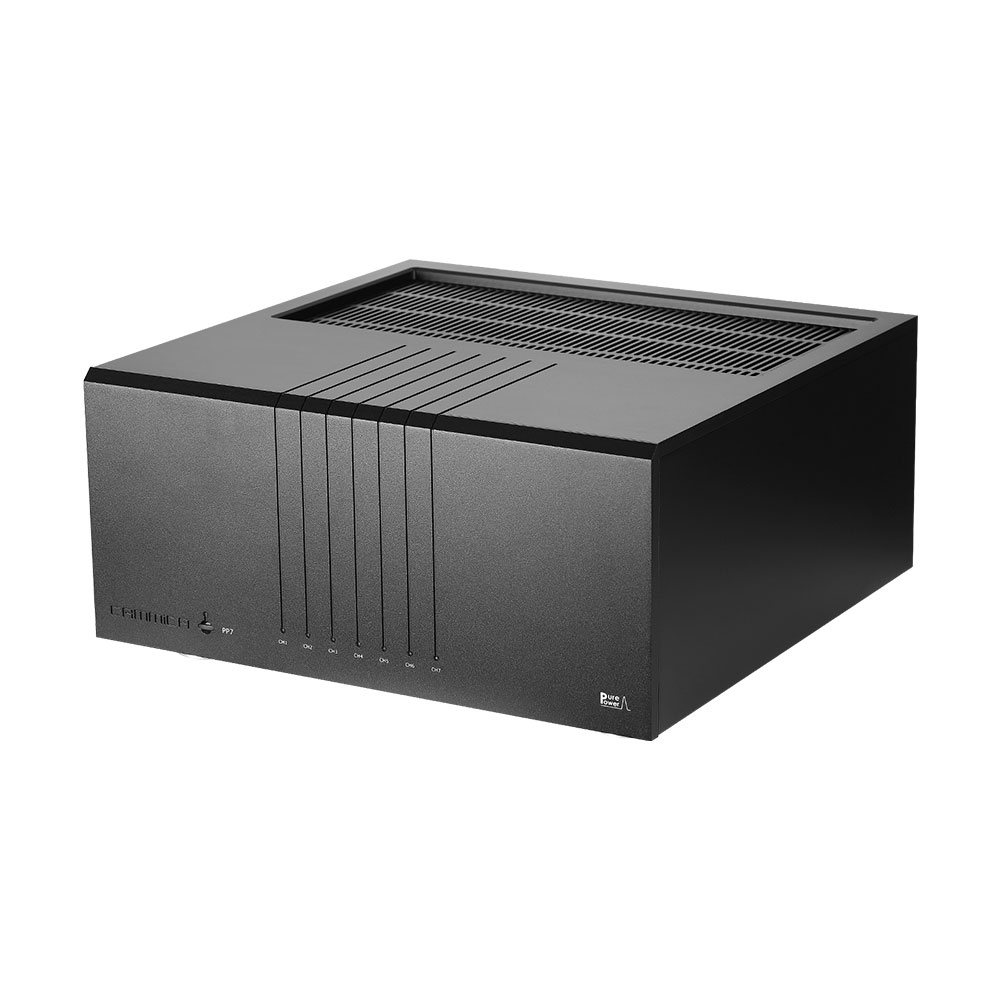
Typical construction: a multichannel amplifier chassis and top ventilation grille — whether peak reserves stay clean depends on the margins in the power supply and thermal design.
For the wider context of power, sensitivity, and loudspeaker matching, see our engineering notes on amplifier power, sensitivity and speaker matching.
The calculation above applies directly to the multichannel amplifier platforms currently in production, listed on the multichannel amplifier and speaker lineup these calculations apply to.
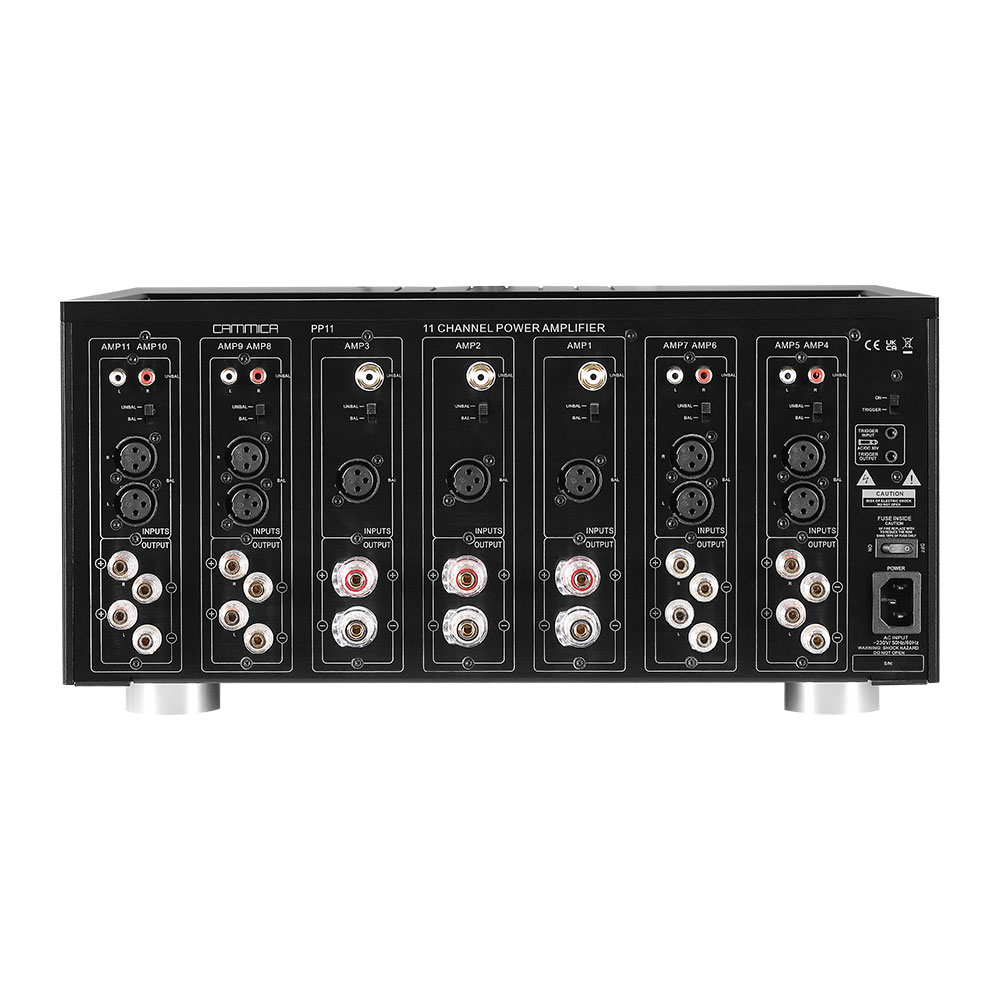
Typical construction: rear-panel channel terminals of a multichannel amplifier — independent per-channel outputs make per-channel power verification possible.
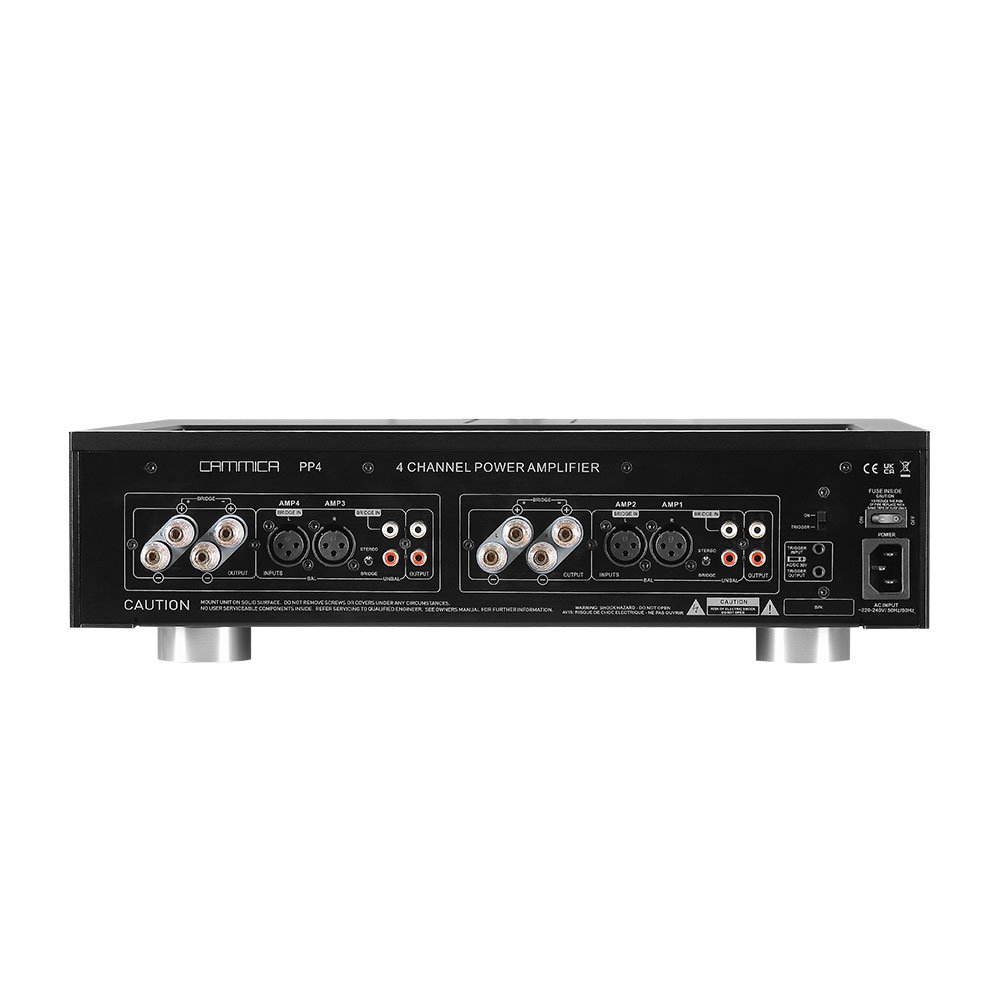
Typical construction: front panel of a multichannel power amplifier.
Last updated: 2026-11-28


