
Views: 0 Author: Site Editor Publish Time: 2026-11-14 Origin: Site
Class AB amplifies continuously: the output devices conduct through the entire signal cycle, like a faucet that is always open and continuously adjusted.
Class D amplifies by switching: the output devices turn fully on and off hundreds of thousands of times per second, and a filter smooths the pulses back into audio.
Efficiency is the root difference: Class AB typically runs at 20–50% in real use; Class D reaches 85% or more. Every other difference — heat, weight, size — follows from this one number.
"Class D sounds worse" is outdated: modern Class D designs measure distortion in the same 0.01% region as Class AB, and the audible gap has closed.
You do not need to pick a side. What matters is knowing which output stage a given amplifier uses, and what trade-offs came with it.
These letters describe how the output stage conducts — how much of each audio cycle the output transistors spend switched on.
Class | Conduction pattern | In one sentence | Typical use |
|---|---|---|---|
A | 100% of the cycle | Most linear, most wasteful | Small high-end stereo |
B | One device per half-cycle | Audible crossover distortion | A textbook stepping stone |
AB | Class B plus bias current | The analog mainstream | Theater power amps, pro audio |
D | High-frequency switching + filtering | The modern efficiency-first design | Multichannel, active speakers, portable gear |
Classes A and B are background knowledge. Nearly every new amplifier you can buy today is a choice between Class AB and Class D.
A Class AB output stage is a push-pull pair: the top device handles the positive half of the waveform, the bottom device the negative half. To remove the distortion "step" where they hand over, a bias circuit keeps both devices slightly conducting at all times — the compromise between A and B, and the source of the name.
Two consequences follow directly:
The waveform is never interrupted. The output tracks the input continuously, which makes distortion easy to characterize and measure.
Heat is a permanent by-product. Even with no signal, the bias current burns power; with a signal, the output devices always support a voltage across them, and everything they waste becomes heat.
A Class D output stage has only two states: fully on, or fully off. The audio signal is first converted into a train of pulses of varying width (PWM, with switching frequencies typically between 300 kHz and 1 MHz). The output devices chop along with it, and a low-pass filter (inductor plus capacitor) averages the pulses back into a continuous audio waveform.
An analogy: Class AB adjusts the faucet opening by hand, continuously; Class D opens and closes the faucet half a million times a second — and as long as the switching is fast enough, the water in the glass looks just as smooth.
Two consequences follow:
When conducting, the voltage across the device is nearly zero, so very little energy is wasted. High efficiency and low heat come from this single fact.
The switching itself is a noise source. Suppressing it — with filters and careful layout — is where all the real engineering effort in a Class D design goes.
The hardest difference between the two classes, and it can be put in numbers.
Item | Class AB | Class D |
|---|---|---|
Theoretical maximum efficiency | 78.5% (full-swing sine wave) | Near 100%; 85–95% in practice |
Real-world efficiency with music | About 20–40% | About 80–90% |
Idle power draw | Tens of watts, bias burns continuously | Usually below 10–15 W |
Take a seven-channel, 250 W-per-channel unit playing music at an average of 20–30 W per channel: the Class AB version draws roughly 80–100 W per channel and turns more than half of it into heat, while the Class D version draws 30–40 W. Over an hour of playback, the Class AB machine generates enough extra heat to raise the internal temperature by a wide margin — which is why Class AB designs need finned heatsinks and sometimes forced airflow, while a Class D design can live in a fully enclosed, slim chassis.

Figure 1 — A large top-mounted heat grille is standard on multichannel amplifiers: the heat the output stage produces has to go somewhere, and the output class decides how much space "somewhere" needs.
The output class dictates the power supply topology, and the power supply dictates the chassis.
Item | Class AB, typical | Class D, typical |
|---|---|---|
Power supply | Large toroidal transformer or big capacitor bank | Compact switching power supply |
Multichannel weight | 20–40 kg | 5–12 kg |
Chassis form | Deep, heavy, large exposed heatsink area | Slim, often fully enclosed |
The back panel is where this becomes visible: the voltage range and VA rating printed beside the IEC inlet, combined with total weight, identify the power supply scheme almost immediately. The power supply is harder to fake than any headline spec — weight does not lie, and a unit claiming 7 × 250 W that weighs only a few kilograms is practically guaranteed to be a Class D design with a switching supply. Weight, not labels, is how you should read any multichannel power amplifier.
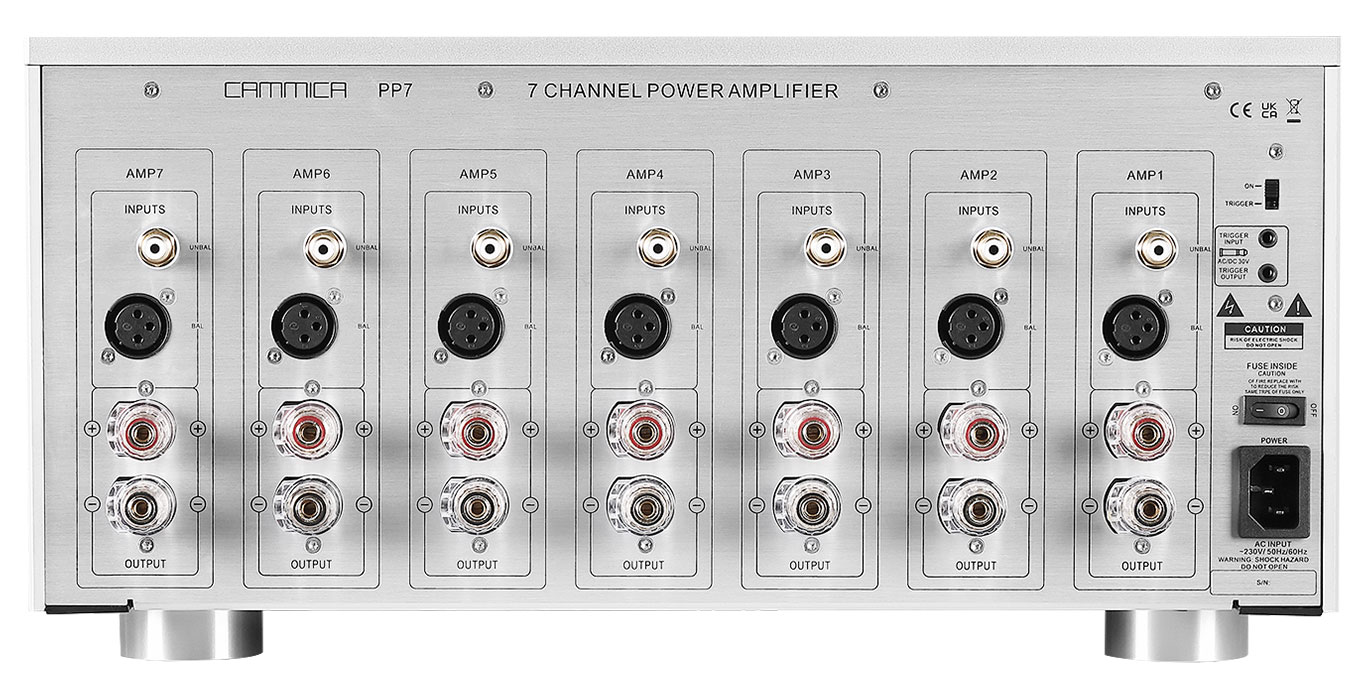
Figure 2 — The back panel is the reading surface of an amplifier: voltage and VA markings at the power inlet, and input specifications, all live on this one panel.
The "Class D sounds digital" reputation dates from a decade ago, when early modulators and output filters genuinely measured worse at high frequencies. Modern designs — chip-based and discrete alike — have closed the gap: distortion now sits in the 0.005%–0.05% band, the same region as Class AB.
Metric | Modern Class AB | Modern Class D |
|---|---|---|
THD at 1 kHz, rated power | 0.005%–0.05% | 0.005%–0.05% |
High-frequency behavior | Flat, no switching noise | Flat when the filter is well designed |
Damping factor | High, stable bass control | Equally achievable |
Where audible differences come from | — | Filter and power supply quality, not the class label itself |
The real dividing line is not between AB and D. It is between good and bad engineering: a Class D unit with a cheap power supply will lose to a well-built Class AB unit, and the reverse is equally true. The class letter is no longer a verdict on sound quality.
A Class D switching frequency lands near the AM and shortwave bands, so a careless layout leaks interference through speaker cables and mains leads. This makes EMC certification more demanding for Class D designs — though once a design is fixed, production consistency is actually easier to hold than with Class AB.
Item | Class AB | Class D |
|---|---|---|
EMI difficulty | Low (no high-frequency switching) | High (switching noise must be suppressed) |
Output filter | Not needed | Required (inductor + capacitor) |
Layout requirements | Conventional | Strict (short switching loops) |
Unit-to-unit consistency | Depends on component spread | High (switching behavior is deterministic) |
For a buyer, certification itself is a health check: a Class D amplifier that has passed CE/EMC testing has had its switching noise verified against legal limits, which is exactly the reassurance the technology needs.
Item | Class AB | Class D |
|---|---|---|
Thermal stress | High; devices and sinks run hot for years | Low; longer component life |
Protection circuits | Overcurrent, overtemperature, DC | Same, plus switching-supply protection |
Service difficulty | Large components, easy to measure | High-frequency section needs an oscilloscope |
Long-term drift | Bias current can drift in older units | No bias concept, so no such drift |
Both classes are reliable enough for commercial duty. The practical difference is the service ecosystem: AB-class repair expertise is everywhere, while Class D switching stages need someone who can read switching waveforms. Volume manufacturers test Class D on the line — burn-in and automated measurement per unit — which narrows the gap further from the buyer's side.
Marketing phrases like "Class D" or "HD amplification" deserve skepticism. Spec tables and back panels do not lie. Six checks:
Idle power draw. Tens of watts or more points to Class AB; under roughly 15 W points to Class D.
Weight and volume. A multichannel unit with high claimed power at only a few kilograms is a switching-supply Class D design.
Cooling structure. Large exposed heatsink fins and airflow channels are classic Class AB; a fully enclosed slim chassis is usually Class D.
Power supply description. "Toroidal transformer" is the classic Class AB pairing; "switching power supply" — or no power supply mention at all — leans Class D.
Efficiency and consumption figures. A modest maximum-power-consumption number suggests Class D; a transformer VA rating suggests Class AB.
Idle noise at the speaker. A defective Class D design leaks a "hiss" from switching noise; a healthy one is as quiet as any AB unit.
Three or four of the six checks agree and the class is settled. Neither weight nor idle draw can be faked — that is what makes this method dependable.
Scenario | Better fit | Why |
|---|---|---|
5+ channel theater systems | Class D | Many channels stressed simultaneously; D handles power and heat with room to spare |
2-channel hi-fi, large-scale classical | Class AB keeps its fans | Preference and tuning headroom; a good Class D performs just as well |
Active speakers / compact installs | Class D | Size and heat constraints are hard limits |
Multi-zone installs | Class D | Total draw and wiring cost are constrained by the electrical panel |
Portable / automotive | Class D | The only realistic option |
The theater row deserves one more sentence. When seven channels drive demanding program material at once, a Class AB design must size its supply and cooling for the worst case, and weight and cost follow. Class D shrinks that entire equation by an order of magnitude — which is exactly why the multichannel theater market moved to Class D over the past decade.
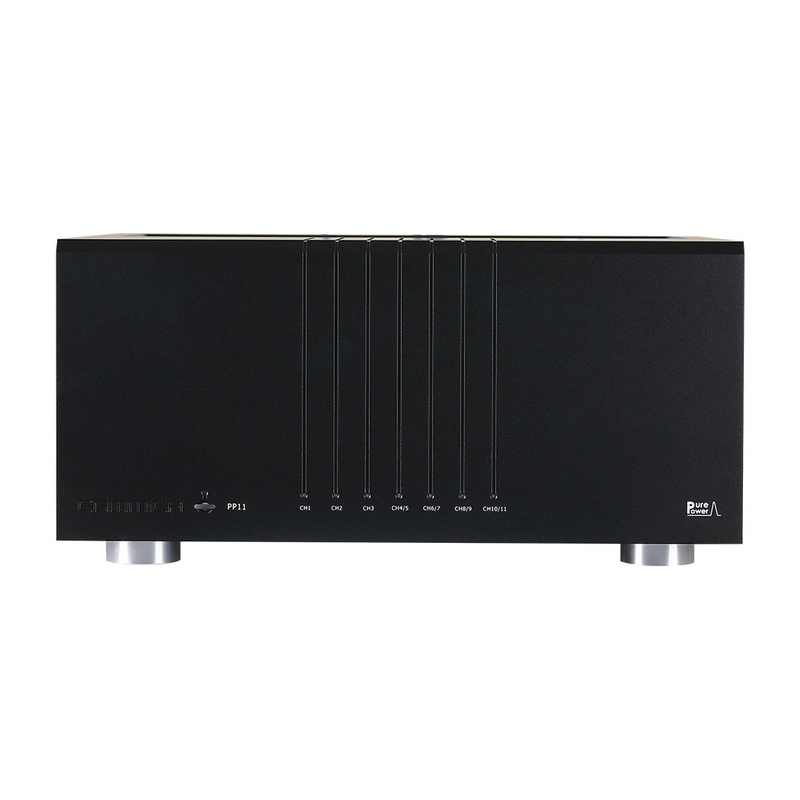
Figure 3 — The typical shape of a multichannel theater amplifier: many outputs, one chassis, one power supply — exactly where Class D saves the volume and the cost in this scenario.
Approach | Idea | Verdict in one line |
|---|---|---|
Class G | Multiple supply rails; low rail for small signals, high rail for peaks | An efficiency-improved Class AB |
Class H | Supply voltage follows the signal envelope | Same idea, more aggressive tracking |
Analog front end + Class D output | Signal processing stays analog, power stage switches | The current mainstream architecture for multichannel |
Classes G and H do not change the "continuous amplification" nature of Class AB; they recover part of what it wastes. When marketing claims "Class G/H approaches Class D," it is talking about efficiency only.
Claim | Reality |
|---|---|
"Class D always sounds worse than Class AB" | Modern designs of both measure in the same distortion band; design quality, not class, decides |
"Class D is a digital amplifier fed with digital signals" | The input remains analog (or is converted); "digital" applies only to the modulation stage |
"Low efficiency makes Class AB unfit for theater" | Fit depends on supply and thermal design, not the class label |
"Lightweight Class D units cut corners" | The weight comes from switching supplies and high efficiency, not missing parts |
"Higher switching frequency always sounds better" | Higher frequency raises losses; mainstream designs balance at 300 kHz–1 MHz |
Q1: Can one unit run some channels in Class AB and others in Class D? Technically possible, rare in the market. Mixing classes complicates the power supply, so most makers standardize on one per chassis.
Q2: Does a Class D amplifier lose power into 4 Ω speakers? Depends on the power supply, not the class. A Class D stage's low-impedance current delivery is set by its switching supply — the 4 Ω column in the spec table is the answer.
Q3: Why do many multichannel amplifiers never mention being Class D? Part of the market still carries the old "Class D = budget" impression, so manufacturers underplay it. That is exactly why the six-check method above exists.
Q4: Does a Class AB amplifier need to "warm up"? Electrically no — bias stabilizes within minutes. Warm-up is mostly a listening habit.
Q5: Can switching noise leak back into source equipment? Not in a competent design. The output filter exists precisely to keep the switching frequency behind the speaker terminals.
Q6: Which class holds value better on the second-hand market? High-power Class AB pro units trade well because service expertise is common; Class D units get cheaper to replace, so resale premiums shrink.
Q7: Will everything move to Class D? Multichannel and installation markets already have. Two-channel hi-fi will keep Class AB alive as a preference, not a performance necessity.
The difference between Class AB and Class D is, at its root, the difference between two physical paths — continuous amplification and switching amplification — and everything else (efficiency, heat, weight, EMI) follows from that. What a buyer should verify is not the letter on the brochure but the three things behind it: the output stage class, the power supply scheme, and the thermal design — the same three things worth verifying on any home theater power amplifier. When those three line up, the class label stops mattering.


